
Feedback: What People Say about LGBT Couple Counselling…
You're considering this counselling service: but what have others said about LGBT Couple Counselling?Feedback and Comments made about Counsellor Dean Richardson & LGBT Couple Counselling as a therapy service for lesbian, gay, bisexual, trans, queer, aroace and other fine clients.Feedback on the Counselling Service
You’re looking for feedback: what others have said about LGBT Couple Counselling.
Protecting other’s privacy who came into counselling is important. It may matter less whether you are seeking counselling as gay couples, lesbian couples, mixed-sexuality couples or groups. It may matter more to you to know that LGBT Couple Counselling is the distinctly better help for your distinct LGBT relationship.
Why distinct? It’s a service that’s significantly more focussed upon LGBT Couples & Groups than, say, other more generic “marriage” therapy services. It’s certainly a more appropriate service to you than the services whose marketing includes phrases like: “the Biblical definition of marriage” (yup, those services are still running today).
I help LGBT couples and groups decide on counselling for their relationship, so that they make an informed decision. The above links high highlight some pages for your interest.
If you have questions not covered above (or on my Frequently Asked Questions Page) please get in contact directly so that we can discuss options together.

What Clients Say (Feedback)
Over 27 years worth of cases (working with over 2,000 people), many clients have spoken about their experience with Dean as their therapist.
Offering an effective approach to counselling with LGBTQ+ couples, throuples and groups isn’t always straightforward, but it can be a rewarding experience.
Here are some summaries of what’s been said about/to Dean…
Amazing how straightforward this turned out to be!
I discovered that we were in an open relationship… I hadn’t known!
We came into counselling to talk about what our relationship needed and what we couldn’t give to each other.
We were concerned that we were heading towards a separation (which we didn’t want). In counselling, we learnt that what we really wanted was to learn how to do some things separately, and by doing more of that, we stayed together.
We were ready to have children, but both of our upbringings were difficult experiences. We wanted to ensure we’d tidied up our history before we welcomed in our first kid.
Neither one of us was listening to the other, so we just kept upping the ante & shouting more. We learned with Dean how to rollback this behaviour and we can hear each other much better now.
I discovered my bf was having an affair (he said “open relationship”, but I hadn’t agreed to that). I needed to talk through my thoughts and feelings privately before I made a decision.
In your (online/directory) profile you seemed very kind.
We wanted to discuss changing to an open relationship. We throught Dean would give us a manual. Instead, with Dean’s help, we developed our own approach.
When my husband came out as gay, we wanted to stay together but didn’t know how (wife).
I needed to talk with my partner about Lesbian Bed Death. I’d been with an individual counsellor; she kind of put me off.
Dean had no problems speaking with me about sexuality, sex and intimacy, and what was happening (or wasn’t happening!) in my relationship.
We met in a a pub and started going out. It was a year before we realised this wasn’t enough to keep us together; we didn’t really know each other and hadn’t learnt very much in that year.
Sexually we have physical problems that make what others consider “normal” impossible for us. We learnt about “non-goal-orientated sex”, and this helped.
Our last counsellor just wouldn’t shut up.
I hadn’t realised how my (undiscovered) past trauma was contributing to the end of my relationships.
I hadn’t realised what I was contributing to the problems; I thought it was only my partner.
We learnt what compromising could mean to our relationship and how we avoided it.
We had fallen out of love. We wanted to get back the relationship we used to have.
As couple counselling progressed, we let go of the idea of recapturing the past (that was lost). Instead we created a newer relationship together.
Our local GU clinic recommended we seek counselling because of one of us was being unfaithful.
We argued over sex. During our counselling, we both discovered that our arguments were covering up fear. Once we addressed our fears, the arguments went away.
We have an age gap of around 20 years. Mostly it’s not a problem, but as I (the elder) grow older, unexpected problems wouldn’t go away in our relationship.
I wanted to leave my relationship.
Effective for 9½ out of 10 Clients *1
Our counselling relationship begins with an initial session to begin evaluating one another (you're seeing if you can work with me, and I'm seeing whether you work well enough with my approach to therapy*4). So in our first session, we will have some conversations and decide whether this early experience appears to have been beneficial enough to continue working together. Two measurements highlight how people generally respond to my counselling approach: my Ongoing Engagement*2 and No Further Engagement*3 Percentages.
During the previous twelve months (October 2025 to September 2026) my Case Measurement Rates have been:-
*1) Measuring over the last twelve full months.
*2) The percentage of clients who continued to attend sessions (for at least one session) after their initial session(s). Some clients complete their work in a short time, and others find that a longer path benefits them; the client chooses how long they stay in private counselling, and the topic is always open for discussion.
*3) The percentage of clients who, from their experience of the initial session(s), decided that the service was not what they were looking for.
*4) Clients who are unable to make effective use of this therapy service are offered assistance in finding alternative services.
The average number of sessions per case is not included here. Because one client's needs differ greatly from another's, a fair comparison cannot be made. No figures are included where the clients were satisfied with the initial session and decided that this was sufficient. Sometimes, extra evaluation sessions are agreed to help us make a more informed decision in more complex situations, but this approach is often unnecessary.
Counsellor Dean Richardson MNCPS(Accred/Reg) 🙋♂️
Of course, you could choose any British-based online couple / throuple / group counsellor…
Yet, given that this will be the most intimate and vulnerable you could be alongside your partner(s), you would want a skilled professional whose experience and specialism you could trust and whose focus would be upon your distinct relationship. Your couple, throuple or group relationship will be in good hands with Dean. He works from Great Britain, is independent of "box 'em/shift 'em" therapy services that you've probably seen advertised, and identifies as a specialist gay relationship counsellor. He's also easily payable in pounds sterling (rather than another country's currency)! Dean already had an impressive 19 years actual video "webcam" experience - way before the first pandemic began in Britain (when suddenly many counsellors added a brand new video option to their portfolio out of nowhere, having never practised online previously 🤔).
What makes Dean Distinct
- Dean is sensitive and effective to your sexuality / gender identity and intimate ways of relating to each other. You'll discover quickly that Dean is an informed member of your own community.
- Dean demonstrates adept skills with lesbian, gay, bisexual, asexual, fluid, non-bonary, mixed-sexuality and same-or-mixed-gender relationships, having over 27 years' experience as a counsellor.
- Dean avoids taking on the role of "all-knowing expert" (whether requested or projected onto him by the clients). "Experts" tell you what to do, do not learn very well from others, and struggle to adapt to new situations. A good relationship counsellor is curious and adaptive and asks questions from a "not knowing" position so that the partners in front of him benefit from re-examination.
- Dean speaks plain English (rather than lots of psychobabble) and, when appropriate and acceptable to you, can swear like a virtuoso as much as you do. In other words, he's an authentic counsellor rather than a stereotypical one. Dean works cooperatively with your relationship (no unnecessary silence or just "hmms..." continually like some do).
- Dean was originally accredited by his first professional body 17 years ago; he is now an accredited registrant with the National Counselling and Psychotherapy Society. Accreditation is a valued recognition of a counsellor's substantial experience. Dean is also a member of the Psychotherapy and Counselling Union of Great Britain.
- Dean is a British counsellor working from the South of England. Unlike other counselling services operating from abroad Dean is registered, accredited, insured & supervised from within England.
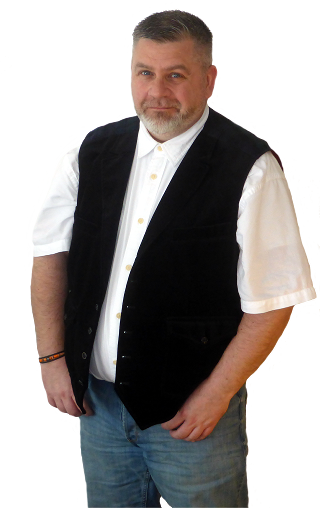
If any of this resonates with you and your partner(s), you should probably meet with the Gay Relationship Counsellor: Dean Richardson MNCPS(Accred/Reg) via Zoom, Teams, WhatsApp and other secure, reliable video conferencing media.
Dean focuses on LGBT/QIA+ relationships as a speciality in therapy. He works with individuals, couples, throuples (three in a partnership), and small groups. Plus, he's qualified to a postgraduate level (Chichester PG Diploma in Psychodynamic / Systemic Couple Counselling, IGA National Foundation in Group Counselling), and works as a private practice counsellor employing 27+ years experience*.
(*Very Important: not all counsellors have specific skills for working with relationships. Those who are initially trained in using common "individual" counselling skills have no experience in working therapeutically with partnerships and even less experience with LGBTQ+ intimate partners. Such counsellors may try, perhaps out of misplaced goodwill, to employ "individual" techniques (multiplied by 2, or 3, or 4), but the client partners will find that the approach is ineffective. Simply put: it's the wrong approach; your relationship is not part of the counsellor's primary theoretical framework. Remember always to ask your potential counsellor, "What qualifies you to work with our relationship?" and trust your instincts based on what you hear.
Further information to help…

Got a Question about LGBT/QIA+ Counselling?
Come and ask... whatever question you have about couple and/or group counselling for gay, lesbian, bisexual, aromatic, asexual and mixed-orientation relationships you might have, get in touch today to discuss your needs…
Private Counselling Services Designed for the LGBTQ+ Community. Available Exclusively to Gay, Lesbian, Bisexual, ASexual, ARomantic, Mixed & Queer Couples, and Established Polyamorous Groups - serving the UK Nationwide over Zoom, Microsoft Teams, Google Meet & WhatsApp Video, reaching locations in and around central Havant, Petersfield to Waterlooville, Cosham to Portsmouth & Southsea, Southampton to Chichester, Fareham to Gosport, Hayling Island, Emsworth, Westbourne, Rowland's Castle, local residents anywhere in between and regularly further afield!