


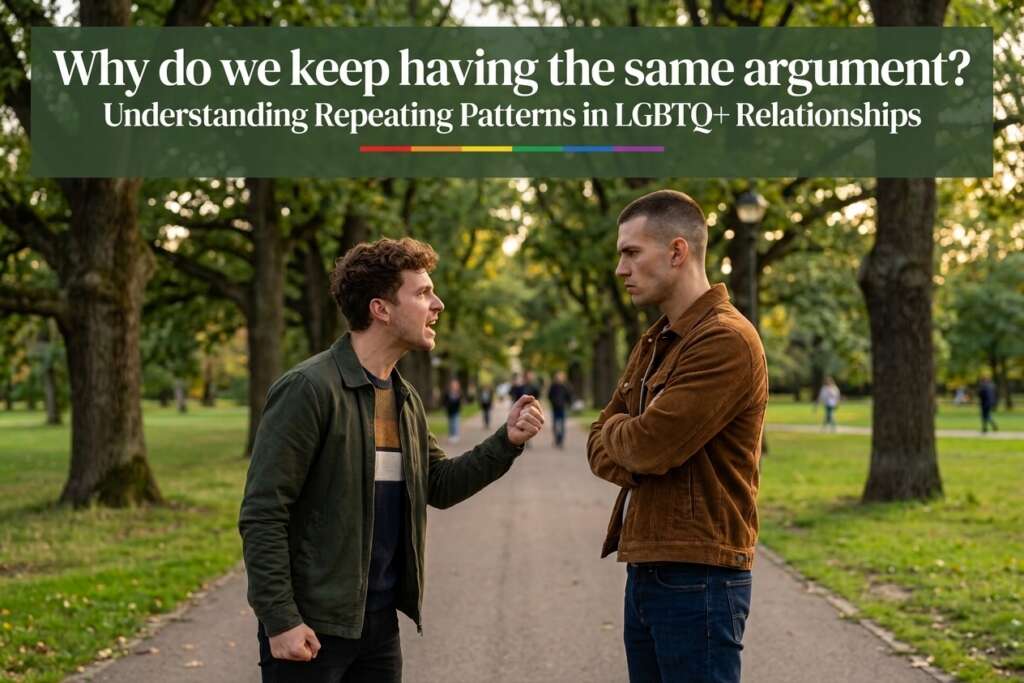
Understanding Repeating Patterns in LGBTQ+ Relationships
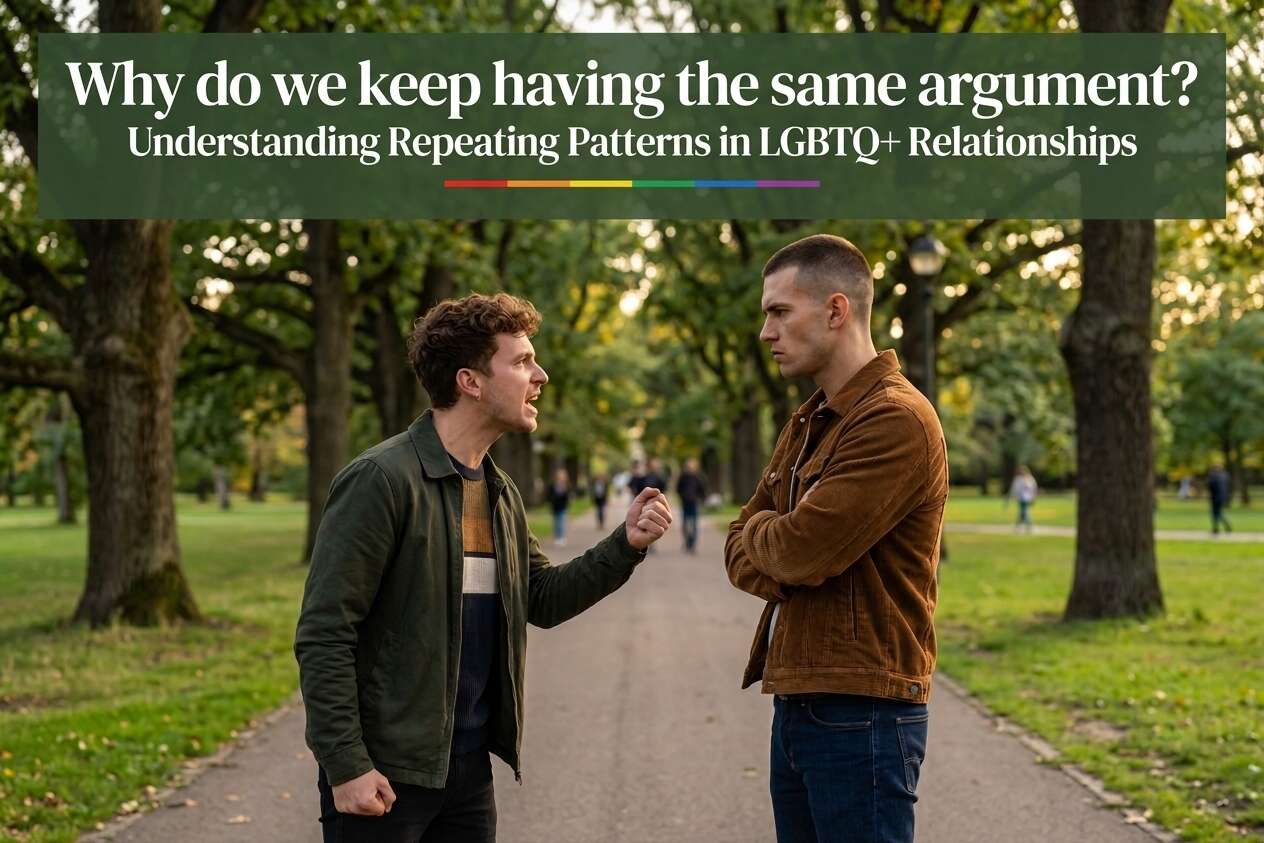
“Why do we keep having the same argument?”
When you and your partner find yourselves returning to the exact same argument time and again, the same sharp exchange over chores, the same familiar silence after a night out, or the exact same shift in tone during a conversation about the future, I can tell you that you are far from alone in this experience.
Introducing Dean Richardson
Hi, I’m LGBTQ+ Couples Counsellor Dean Richardson MNCPS (Accred/Reg), and as a couple counsellor working with gay, lesbian, bisexual, transgender, and queer partners for almost three decades, I regularly meet couples who feel completely exhausted by these recurring loops.
Couples can arrive in counselling wondering why two people who love each other deeply can so easily become trapped in the same script, reciting lines they both know by heart, and yet feel powerless to change the patterns.
You’re not Broken
So, firstly, I want to reassure you that having the same argument over and over does not mean your relationship is broken. Nor does it mean you are incompatible.
In fact, repeating arguments are rarely about the superficial trigger, whether that’s a sink full of dishes, a delayed text, or a disagreement about social plans. Instead, these loops are dynamic patterns created between you. They are emotional feedback systems where both partners are usually trying to protect themselves or seek reassurance but doing so in ways that trigger the other person’s defences.
(That’s going to be on the examination at the end, by the way: triggering the other person’s defences! 😉)
In LGBTQ+/same-sex relationships, these behaviour patterns can carry unique layers of meaning. Minority stress, past experiences of rejection or hiding, hyper-vigilance, and internalised shame can quietly sit in the room with us, shaping how we interpret a partner’s tone or distance.
The Mechanics of an Argument Loop
Let’s talk about the mechanics of the argument loop. I’ll introduce you to two ways of thinking, each from a systemic and psychodynamic perspective (this stuff isn’t on the test 😁).
I’ll not talk all theoretical framework-ey, but stick with plain English.
If we’re going to help you break out of an argument loop, I have to help you understand how such loop patterns form in the first place.
A Psychodynamic Perspective
From a psychodynamic perspective, into our adult partnerships we (helplessly) bring in our earlier life experiences, attachment histories, and defensive mechanisms.
For example, if we grew up feeling that our emotional needs were a burden or that love was conditional, a minor sign of distraction from our partner might feel to us like abandonment (without us knowing why).
A Systemic Perspective
From a systemic perspective, relationship behaviour is usually a circular system rather than a linear one. It isn’t a case of “Partner A causes Partner B to react.” Instead, it’s more of a case of: “Partner A’s protective response activates Partner B’s vulnerability, which then prompts Partner B’s protective response, which in turn reinforces Partner A’s original fear (and so on).”
When both partners feel unsafe and act out of self-defence, their relationship system (make a note of that phrase!) gets stuck in a dance where nobody gets what they actually need.
Now you’re ready
With these two pieces of knowledge, we’re now ready to introduce you to three brief techniques for breaking out of an argument loop.
Three Approaches to Breaking Out of Repeating Arguments

Breaking an argument loop
This advice is going to sound strange, but breaking a repeating pattern doesn’t require “winning” the argument or getting your partner to admit that they were wrong.
Nope, instead it requires changing your position in the cycle. Do you see the image attached to this section? That’s a clue!
Here are three practical approaches rooted in systemic and psychodynamic couple counselling practice that you can begin exploring together.
1. Alter ONE Step in the Sequence

Stepping from the Cycle

Sticking within the Cycle
Because relationship systems operate like clockwork, changing even one minor response disrupts the entire mechanism.
If Partner A always pursues and Partner B always withdraws, the loop continues automatically.
But, if either partner recognises that they’re in the loop again and then consciously alters their next step, the old script can no longer play out as written.
- HOW TO TRY THIS: Identify your typical automatic response in the argument. If you usually raise your voice, try lowering your volume or taking a slow breath. If you usually walk away immediately, try staying present for two extra minutes while acknowledging your distress with your partner. If you usually defend yourself with logic, try acknowledging your partner’s emotional distress first before explaining your perspective.
- WHY IT CAN WORK: A pattern requires both participants to play their habitual roles (Step 1 leads to Step 2, which leads to Step 3, etc.). By changing your input into the relationship system, you force the system to adapt, creating a new opening for a genuinely new conversation to take place.
2. Externalise the Pattern (Name the “Third Entity”)

Externalise the behaviour pattern
In systemic therapy, we often view the argument itself as an external force operating between the partners, rather than assigning blame to either individual.
When a dispute arises, it is natural to view your partner as the adversary.
However, when you both step back and look at the cycle together, the adversary becomes the pattern itself.
- HOW TO TRY THIS: Give your recurring argument a neutral, descriptive name, such as “The Pursuit and Retreat” or “The Freeze.” When you feel the familiar tension rising, practise calling it out together: “Do you see that we’ve made ‘The Freeze’ happen again, right now?”
- WHY IT CAN WORK: Naming the pattern shifts you from fighting each other to standing side-by-side to observe a process that is affecting both of you. It creates psychological distance and reduces defensiveness, allowing you to step out of the argument trap.
3. Identify the “Under-the-Iceberg” Emotional Drivers

Under the Iceberg
Psychodynamic thinking reminds us that the primary emotion we display during a fight (often anger, frustration, or cold detachment) is usually a secondary defence. Beneath the surface lie primary vulnerabilities: fear of inadequacy, fear of rejection, shame, or feeling invisible.
In queer relationships, these primary feelings may often be linked to historic experiences of not feeling safe or fully accepted.
- HOW TO TRY THIS: The next time you feel the urge to voice a familiar complaint or retreat into silence, take a brief pause and ask yourself: “What primary emotion am I actually feeling right now beneath my anger or defensiveness?” Is it sadness? A fear of being cast aside? A feeling of not being good enough? Share that feeling with your partner.
- WHY IT CAN WORK: Expressing a primary vulnerability (“I felt afraid that I don’t matter to you when that happened”) invites connection and comfort from a partner, whereas expressing a secondary defence (“You never listen to me!”) invites a defensive counter-attack back at you.
Moving Forward Together
Unpicking long-standing relationship patterns takes some curiosity, a little patience, and a willingness to look beyond the immediate source of friction.
Reaching a point where you recognise the loop while it’s happening, even if you can’t always stop it immediately, will be a significant step forward for you together.
The above three techniques aren’t magic, but they are “thinking outside of the box”. They won’t resolve your stuck cycles on their own; they need you both to invest a little and go with what they’re trying to achieve.
By shifting your focus from “who is right?” to “what is happening between us?”, you make room for deeper understanding, softer interactions, and a relationship that feels safer and more connected for both of you.







0 Comments