


 How to Rebuild Trust After Cheating: Can an LGBTQ+ Relationship Recover?
 Throuples don't Know they can seek Relationship Counselling too
 LGBTQ+ Video Counselling for Couples, Throuples & Groups
 Beyond "Fixing Us": How Couples Counselling Actually Benefits LGBTQ+ Partners
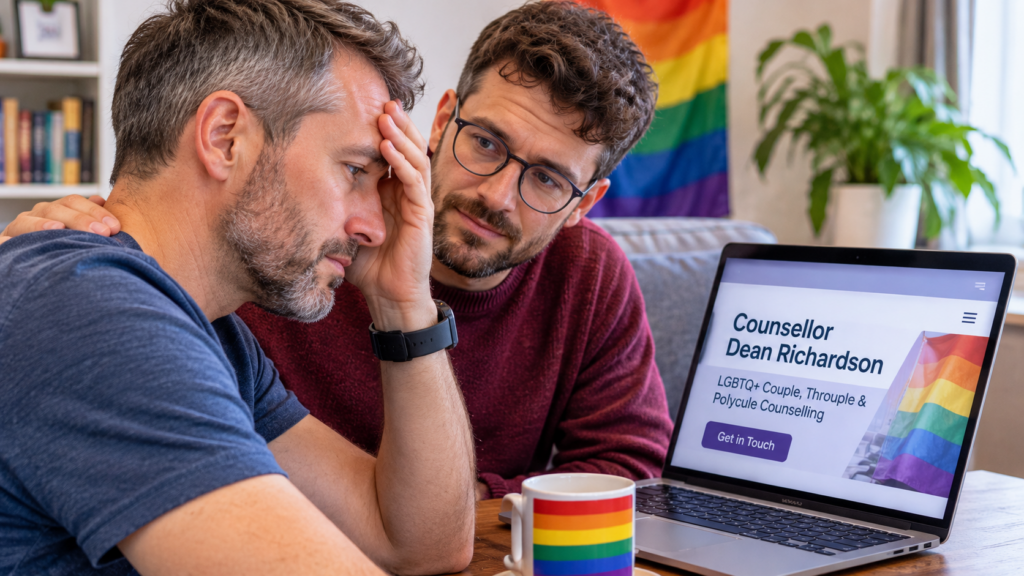
Many people think of relationship counselling as something you turn to when a relationship is struggling to survive. Perhaps arguments have become frequent, trust has broken down, or one partner is considering leaving.
But what if counselling is helpful when engaged much earlier than you’d think?
For LGBTQ+ couples, throuples and polycules, relationship counselling can provide an opportunity to understand one another better, address emerging difficulties and make important decisions together. You don’t need to be on the verge of separating to benefit from talking to a relationship counsellor.
Sometimes, the most useful time to seek counselling is when you first notice that something isn’t quite right.
Perhaps you’re having the same argument repeatedly. Maybe you’re finding it difficult to discuss a significant life decision. Or perhaps your relationship is changing, and you want to understand what those changes mean for everyone involved.
Thinking of your counsellor as your “relationship consultant” can actually help address and avoid feelings of shame or failure when going to see a professional relationship counsellor.
So, recognising these moments can help you decide whether relationship counselling with Counsellor Dean Richardson – even just for a handful of brief sessions – could be beneficial to you both.
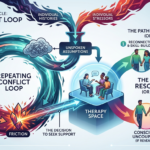
1. You’re having the same argument repeatedly.
Does a particular disagreement keep resurfacing?
Perhaps one of you feels that the other isn’t listening. Maybe you disagree about how much time you should spend together, how household responsibilities are shared, or how affection and intimacy are expressed.
You might resolve the immediate disagreement, only to find yourselves having almost exactly the same conversation a few weeks later.
Repeated arguments often indicate that something more fundamental remains unresolved. The disagreement itself may be less important than the feelings, expectations or needs underneath it.
For LGBTQ+ couples, throuples and polycules, these underlying issues can sometimes involve assumptions about relationships that differ from those held by family, friends or wider society.
Counselling can help you understand what keeps the disagreement alive, rather than simply trying to resolve the latest argument.
2. You’re finding it increasingly difficult to communicate.
Perhaps you used to find it easy to talk about anything. Now, certain subjects seem to result in defensiveness, frustration or withdrawal.
One partner might feel that they have to choose their words carefully to avoid upsetting the other. Another might feel that their concerns are routinely dismissed.
In a throuple or polycule, communication difficulties can become more complicated. A conversation between two partners may affect a third person. Information might be shared unevenly, or one person might feel excluded from decisions that affect the wider relationship.
You don’t necessarily need to be arguing to have a communication problem. Sometimes, the difficulty is that important conversations simply aren’t happening.
A counsellor can help partners explore how they communicate, what makes certain conversations difficult, and how everyone can have a voice.
3. You’re wondering whether your relationship agreements still work.
Relationships evolve. Agreements that made sense when you first got together may no longer reflect your circumstances or needs.
For example:
- A monogamous couple might be discussing whether to explore consensual non-monogamy.
- A throuple might be reconsidering how time, affection and commitment are shared.
- A polycule might need to revisit agreements about dating, sexual health, disclosure or overnight stays.
- Partners might discover that their expectations of commitment are different.
These conversations can be difficult, particularly when one person is enthusiastic about a change and another feels uncertain.
The important question isn’t necessarily whether an agreement should change. It’s whether everyone has the opportunity to express their needs, understand the implications and make an informed decision.
Relationship counselling can provide a space to explore these questions without assuming that any particular relationship structure is the right one.
4. You’re approaching a significant life change.
Not every reason to seek counselling involves conflict.
Sometimes, you simply need to think carefully about a decision that could change your relationship.
Examples include:
- Deciding whether to have children and how you might approach parenting.
- Considering retirement and how you will spend more time together.
- Changing career, particularly when this affects finances, location or time available.
- Moving abroad or relocating within the UK.
- Buying a home together or making a significant financial commitment.
- Deciding whether to introduce a new partner into an established relationship.
- Considering changes to your relationship structure.
You might feel that you agree about the decision but have different expectations about what it will mean. For example, one partner might imagine that retirement will involve spending much more time together, while the other is looking forward to pursuing individual interests.
A counsellor can help you explore these expectations before they become sources of resentment or disappointment.
You don’t have to wait until the decision has been made and the consequences become difficult to manage.
5. One of you feels that your relationship has become unequal.
Do you sometimes feel that one partner’s needs take precedence over everyone else’s?
Perhaps one person makes most of the decisions. Maybe one partner is doing more of the emotional work, or another feels that their needs are consistently overlooked.
In a throuple or polycule, perceived inequalities can be particularly difficult to discuss. For example, an established couple might unintentionally give greater priority to their existing relationship when making decisions involving a newer partner. Alternatively, one person might feel that they are expected to accommodate everyone else without having an equal opportunity to express their own wishes.
These situations don’t necessarily mean that anyone is deliberately behaving unfairly.
Counselling can help everyone explore how decisions are made, whether expectations are understood, and what a more satisfactory arrangement might look like.
6. You’re experiencing changes in intimacy or emotional connection.
Perhaps you’re spending less quality time together. Maybe physical intimacy has changed, or you feel less emotionally connected than you once did.
Changes in intimacy can arise for many reasons, including stress, changing priorities, differences in desire, or unresolved relationship difficulties.
For LGBTQ+ couples, throuples and polycules, there may also be questions about how intimacy is understood and negotiated across different partnerships.
It can be difficult to avoid assuming that a change in intimacy means that your relationship is failing. However, changes in desire, affection or connection don’t automatically mean that something is wrong. What matters is how those changes affect the people involved and whether they can be discussed openly.
A counsellor can help partners explore what intimacy means to each of them, what has changed, and whether there are ways of reconnecting that feel appropriate to everyone.
7. Something has happened that has affected trust.
Trust can be affected by many different experiences.
Perhaps a partner has broken an agreement. Maybe information has been withheld, or one person feels that a significant decision was made without their involvement.
In consensually non-monogamous relationships, difficulties might involve an agreement about disclosure, sexual health, boundaries or the introduction of another partner.
The issue isn’t necessarily whether the relationship is monogamous or non-monogamous. It’s whether the people involved feel that their agreements and expectations have been respected.
When trust is affected, it can be difficult to know how to move forward.
Counselling may help you understand what happened, how each person experienced it, and what would be needed to rebuild trust, if that is what everyone wishes to do.
Seeking help early can make it easier to have these conversations before mistrust becomes deeply entrenched.
8. You’re feeling disconnected but can’t quite explain why.
Sometimes, there isn’t one obvious problem.
You might still care deeply about one another. You may rarely argue. Yet something feels different.
Perhaps you’re functioning well as a household but no longer feel emotionally close. Maybe you have become so accustomed to your routines that you rarely discuss what you want from the relationship.
In a polycule, this might involve feeling connected to one partner but increasingly distant from another.
You might find yourself wondering:
- Are we still getting what we need from this relationship?
- Have we stopped making time for one another?
- Are we assuming that everything is fine because we aren’t arguing?
- Have our individual needs changed?
These are worthwhile questions in their own right.
Counselling can offer a reflective space in which to explore your relationship, even when you cannot identify a specific problem that needs fixing.
9. You’re beginning to question whether you want to stay together.
Perhaps one of you has started thinking about separation.
You may feel uncertain about whether the relationship can continue in its current form. Alternatively, you might know that something needs to change but have no idea what that change should look like.
At this stage, relationship counselling doesn’t have to be about saving the relationship at all costs. It can help you understand your feelings, consider the available choices and explore whether there is a way forward that everyone can accept.
Sometimes, partners discover that they want to continue together but need to make significant changes. Sometimes, they discover that separating is the most appropriate decision.
Either way, counselling can help you approach the decision with greater clarity and understanding.
10. You can no longer tolerate being in the same room together.
There is an important distinction between seeking counselling when difficulties first emerge and seeking it when a relationship has reached a very late stage of conflict.
If you and your partner can barely tolerate being in the same room, conversations routinely become hostile, or one person has completely withdrawn, counselling can become considerably more difficult.
This doesn’t mean that counselling is necessarily impossible or that you should give up.
However, by this stage, the emotional work required may be considerably greater. There may be years of accumulated resentment, hurt or mistrust to address before you can begin to explore the underlying relationship difficulties.
If you recognise that your relationship is heading in this direction, it may be worth making contact sooner rather than waiting for the situation to deteriorate further.
Where there is coercive control, intimidation, abuse or fear for someone’s safety, joint relationship counselling may not be appropriate. Individual support and specialist safeguarding advice may be needed instead.
Counselling isn’t just about resolving problems.
It is worth remembering that relationship counselling can serve several different purposes.
You might engage a counsellor because you want to:
- Understand a recurring difficulty.
- Improve the way you communicate.
- Explore differences in expectations.
- Make an important life decision.
- Develop a greater understanding of one another.
- Revisit relationship agreements.
- Strengthen your emotional connection.
- Decide whether to continue your relationship.
- Understand how your relationship has changed over time.
You don’t need to arrive with a clearly defined problem or a particular outcome in mind.
Sometimes, the starting point is simply recognising that there are things you would like to understand better.
When might be the best time to contact your relationship counsellor?
There isn’t a single right answer, but more of trusting your best sense.
If you recognise any of the following, counselling may be worth considering:
- You are having the same disagreement repeatedly.
- You are finding it difficult to discuss something important.
- You are making a significant decision that will affect your relationship.
- You feel that your relationship agreements need reviewing.
- You are experiencing changes in intimacy or emotional connection.
- You are uncertain about the future of your relationship.
- You want to understand one another better, even though things are generally going well.
The key is not to wait until your relationship becomes intolerable before seeking support.
Counselling can be a constructive way of addressing difficulties while you still have the emotional space to explore them together.
Relationship counselling with Dean Richardson MNCPS(Accred/Reg)

Dean Richardson MNCPS(Accred/Reg)
My effective approach to relationship counselling (science bit coming up) integrates systemic and psychodynamic perspectives. This means that we can explore both the patterns of interaction within your relationship and the feelings, experiences and expectations that may influence how you relate to one another. Doing this helps bring new understanding of your relationship, which all partners can use to help improve things.
You don’t need to be in crisis to make contact with me. You might simply want to understand a recurring disagreement, think through a significant life change, or explore whether your relationship is meeting everyone’s needs.
If you recognise something in this article that reflects your own relationship, get in touch; it costs nothing to have a brief email exchange.
You don’t have to wait until things become difficult to talk about them.
Find out more about LGBTQ+ Relationship Counselling Services…



0 Comments