

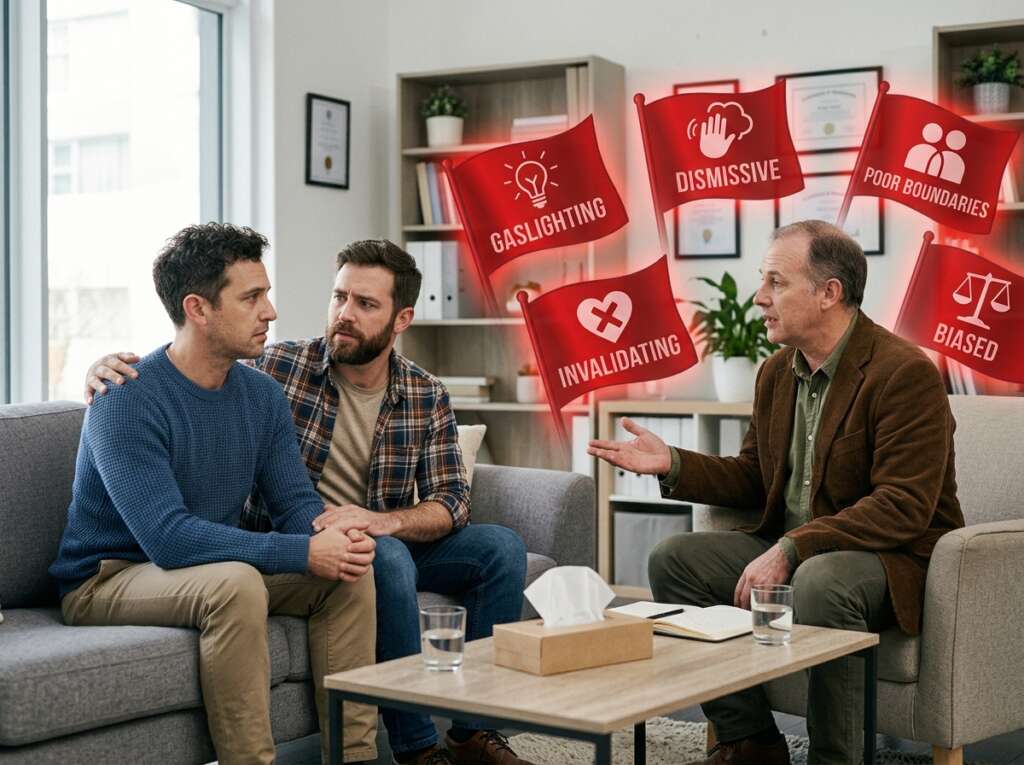
Finding the right couple counsellor for an LGBTQ+/Queer couple relationship means balancing specialised therapy skills with appropriate neutrality.
But what does this mean in plain English to a couple who are looking for a professional to help them repair their broken partnership?
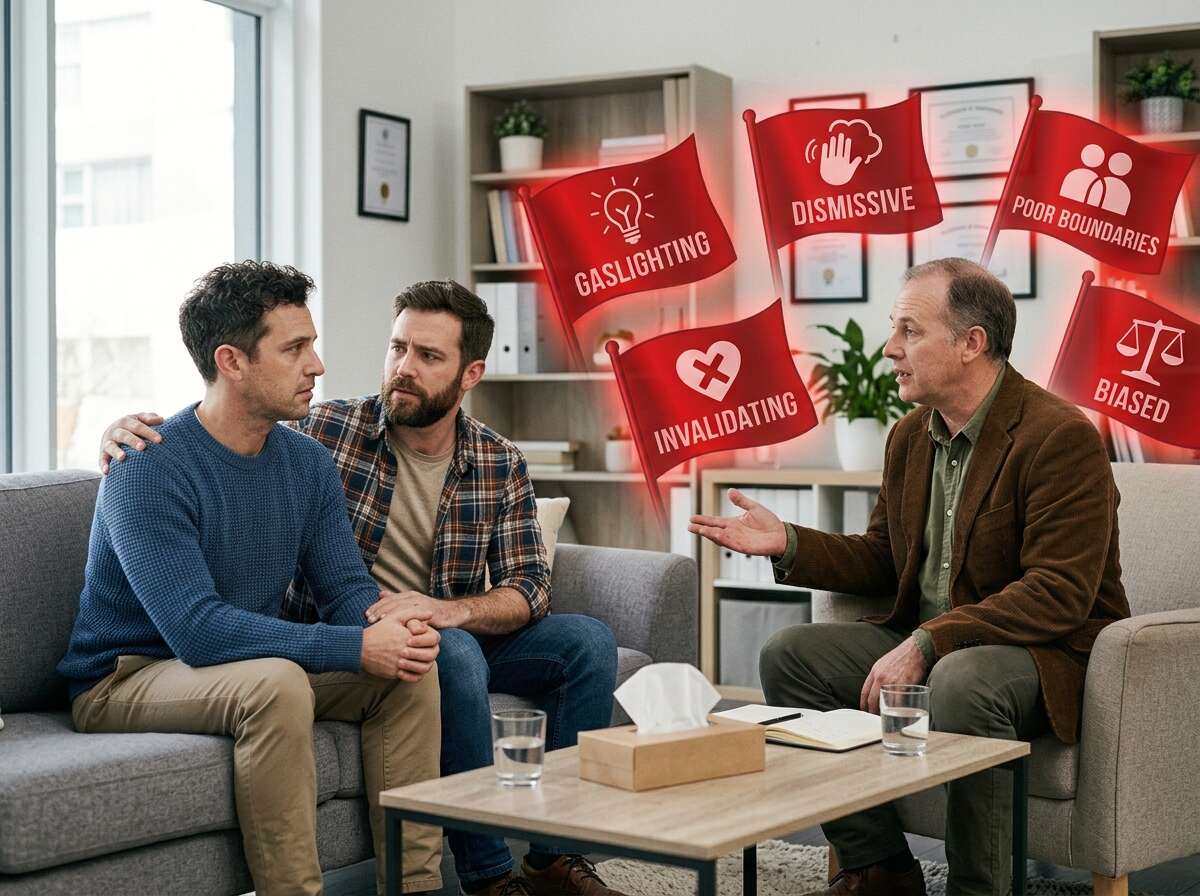
Recognising red flags (potential warning signs) early ensures you both protect your emotional well-being and, instead, can invest time in a genuinely productive therapeutic experience.
Warning Signs of a Red-Flag Counsellor
Counsellors trained to work with couples have advanced knowledge of how relationships work (and don’t work), what problems a partnership dynamic has, how to work with a couple’s relationship, and how to keep two people safe in the room (three, if we include the counsellor).
But not all couple counsellors understand LGBTQ+ partnerships.
The simple, immediate red flags of your couple counsellor include:
Qualifications/Training
- Lack of specialised couples training:
In the UK, initial training in counselling typically focuses on individuals. Individual counselling is very different from relationship counselling (whether for couples, throuples or groups). A practitioner without explicit (post)graduate training or accreditation in couples work (e.g., systemic, psychodynamic, EFT, or Gottman methods) will be unprepared to work with a couple’s relationship, can accidentally allow conflict to escalate, and lack fundamental relationship theoretical frameworks that help them navigate through your relationship problems. - Continued professional development (CPD):
Qualified counsellors are required to continue their professional development by a mix of attending additional training or workshops or reading and watching additional educational material (a minimum of the equivalent of 30 hours per year) in appropriate subjects that assist and enhance their practice.
Ignorance of LGBTQ+ Partnerships and Lifestyle
- Treating LGBTQ+ relationship problems as the problem:
A red flag is when relationship difficulties are routinely explained by a partner’s sexuality or gender identity, rather than exploring the couple’s actual relationship dynamics.. - Assuming heterosexual relationship norms apply:
Has for assumptions about gender roles, sex, marriage, monogamy or family life that don’t reflect the particular relationship in front of the counsellor. - Is uncomfortable discussing sex or relationship structures:
A counsellor should be able to discuss sexual boundaries, consensual non-monogamy and different relationship structures without treating them as inherently problematic. - Knows the terminology but doesn’t understand the experience:
Using inclusive language or claims“I work with everyone” is not the same as having relevant experience and skills in working with LGBTQ+ couples.
Session Management
- Taking sides or playing the judge:
Most qualified relationship counsellors treat the relationship as the client, rather than the two individuals. Other rationales may treat the couple as distinct partners. If the counsellor repeatedly gangs up on one partner, assigns blame, or declares a “winner” in arguments, they compromise safety. - Secret-keeping and poor boundary management:
A strong practitioner sets clear rules regarding individual communication between sessions. If they hold major secrets shared by one partner without addressing how that impacts joint work, trust breaks down. - Poor session management:
Allowing sessions to turn into unstructured screaming matches without intervention, or doing most of the talking themselves, indicates weak control of the therapeutic space.
Personal vs. Professional Beliefs
- Pathologising or invalidating identity:
For LGBTQ+, ethical non-monogamous, or kink-aligned couples, a major red flag would be a counsellor who attributes unrelated relationship issues entirely to your gender identity, sexuality, or relationship structure. I wouldn’t suggest they’d say to a gay man: “If you married a woman, you wouldn’t have these problems,” but perhaps they demonstrate their lack of knowledge through clumsy, unhelpful interventions. - Imposing personal values:
Counsellors should never impose their personal beliefs on how a couple should behave (example: separating or staying together), nor push their own moral frameworks onto your relationship choices (eample: “I wouldn’t sleep around like you do”).
Red Flags vs. Green Flags – Direct Comparison
Here’s a summary of red flags vs green flags to be aware of in your couple counsellor.
| Category | Red Flag Behaviour 🚩 | Green Flag Behaviour 🟢 |
|---|---|---|
| Bias & Neutrality | Sides with one partner during discussions or uses language that declares a “winner” in disputes. | Maintains a neutral position and a balanced focus, helping both partners to see their contributions or making interventions in a way where both partners learn something about their and/or their partner’s position. |
| Identity & Lifestyle | Blames your relationship issues on queer/LGBTQ+ identity or on the practice of non-monogamy. | Demonstrates affirmative awareness of LGBTQ+ and non-traditional relationship structures. |
| Qualifications | Has only general individual counselling training with no couples focus. | Holds (post)graduate qualifications specifically in couples or systemic therapy. |
| Supervision | Has no supervision arrangements, despite their practice requiring such (i.e. psychoanalysts may self-supervise). | Regular supervision arrangements are in place (e.g., 90 minutes per month), and arrangements for additional supervision are in place when they deem necessary. |
| Structure & Focus | Allows sessions to devolve into unguided shouting matches. | Interrupts unhealthy cycles actively to keep the space emotionally safe. |
| Boundaries | Keeps major secrets passed via private emails/calls from one partner. | Is clear about a transparent “no secrets” policy in all communications, though they respect the need for individual communication in exceptional circumstances (e.g., domestic violence) and manages such communication within the couple relationship. |
| Authenticity vs Avoidance | Avoidance: dodges your queries by giving a flamboyant, indirect response. | Authenticity answers your question directly, or at least as honestly as they feel is helpful at the time. |
| Session management | Does not intervene during arguments, or does so without rationale (i.e. they’re frightened to intervene, rather than having made a considered decision not to do so). | Works with the couple about an argument, possibly interrupting the argument or striking when the iron’s colder; but the couple learns something from the interaction |
Questions to Ask During an Initial Consultation
Before committing to therapy, use a consultation call to screen prospective practitioners. Key questions to ask include:
What training do you have in couples counselling?
Ensure they hold specific and/or recognised (post)graduate qualifications or certifications rather than relying solely on individual therapy credentials.
In plain English, would you explain your theoretical framework for us?
This not only informs you on how the couple counsellor will approach relationship counselling, but also, by asking for a plain English description, shows whether the counsellor has sufficient depth of knowledge to translate academic knowledge (required to pass their qualifications) into plain English.
What is your approach to confidentiality and individual communications between sessions?
An experienced relationship therapist will have a clear “no secrets” policy regarding private calls or emails, notwithstanding in some exceptional situations (such as domestic violence) communication with one partner may be initiated by one partner.
How experienced are you with our specific dynamic or identity?
Ask directly about their familiarity with LGBTQ+ dynamics, neurodivergence, or ethical non-monogamy if relevant to your relationship.
How do you structure sessions if conflict escalates?
Listen for a confident strategy aimed at maintaining physical and emotional safety in the room.
Professional Memberships?
Some recommend asking about a counsellor’s professional membership body/bodies, e.g., National Counselling and Psychotherapy Society (NCPS), United Kingdom Council for Psychotherapy (UKCP), British Psychoanalytic Council (BPC), British Association for Counselling and Psychotherapy (BACP), etc. In all honesty, whilst a professional body might provide you with somewhere to go if your complaints are not met by the counsellor, you’re much better off raising complaints directly with the counsellor in order to solicit change, rather than asking a professional body to tell them off long after the experience (notwithstanding, severe professional negligence may best be reported to a professional body or even the police where applicable).
How to Raise Concerns or Change Therapists
If you notice red flags during therapy, you are not obligated to stay. Here is how to handle the situation constructively:
- Address it directly in session: Bring up your observation gently (e.g., “I felt like the focus was uneven today”). A good couple counsellor will welcome feedback and adjust their approach as necessary.
- Evaluate their response: A green-flag practitioner responds with curiosity and openness. If they become defensive, dismissive, or blame you, it confirms the incompatibility.
- Make a clean exit: You can pause or terminate therapy at any point. A brief email stating that you have decided to seek a practitioner whose style aligns better with your needs is entirely sufficient.
Interested in the Specialist LGBTQ+ Partnership Counsellor?

Dean Richardson MNCPS (Accred/Reg)
Making an appointment for an initial session of couples counselling doesn’t bind you to a long contract.
Dean is a postgraduate-qualified systemic and psychodynamic couple counsellor with more than 27 years’ counselling experience. His private counselling service provides specialist relationship counselling online through secure video, allowing couples to work with a counsellor without, say, having to travel to a counselling office each week.
Find out more about LGBTQ+ Couple Counselling for Couples…







0 Comments