


 Common Problems LGBT Couples Resolve in Counselling
 Couple Counsellors: Working with LGBTQ+ Relationships
 Sex Counselling for LGBT Couple Relationships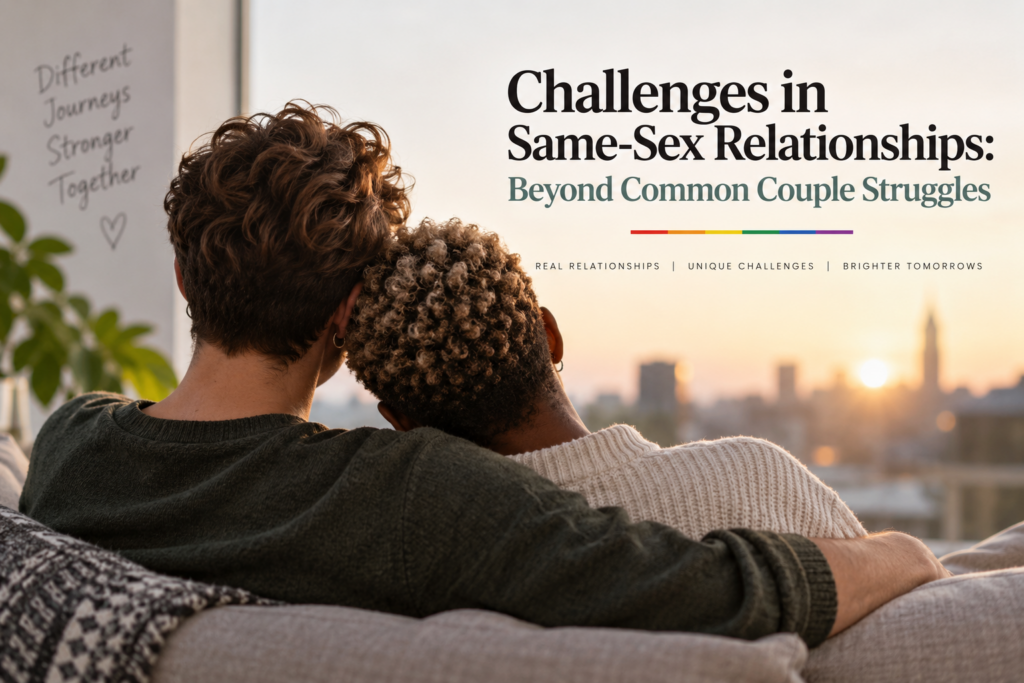
Every relationship has its difficulties. Couples may argue about money, sex, household responsibilities, family, communication or how much time they spend together.
Same-sex relationships can experience all of these ordinary relationship challenges too. Being gay, lesbian, bisexual or queer does not automatically create relationship problems.
However, there can be additional pressures surrounding the relationship that heterosexual couples may not encounter in quite the same way. Challenges same-sex partners face can include pressures that may influence how the partners communicate, experience intimacy, make decisions and understand what their relationship is supposed to look like.
Understanding those influences and pressures can be an important part of resolving difficulties in their most significant relationships.
External Pressures Can Become Relationship Pressures
No couple relationship exists in isolation. Family attitudes, social expectations, previous experiences of discrimination and concerns about being visibly LGBTQ+ can all become part of the relationship’s emotional landscape.
For some LGBTQ+ couples, this might involve:
- An unsupportive or rejecting family member;
- Different levels of acceptance from friends or relatives;
- Anxiety about being visibly affectionate in public;
- Previous experiences of homophobia or discrimination;
- Different expectations about marriage, children or family life;
- Pressure to conform to heteronormative expectations;
- Concerns about whether a partner will be accepted by family or social networks.
Sometimes these pressures are obvious. At other times, they become woven into everyday disagreements.
For example, one partner may interpret another’s reluctance to attend a family event as a lack of commitment. The other partner may actually be trying to protect themselves from rejection or conflict.
The disagreement is real, but it may not be the whole story.
This is one reason specialist LGBTQ+ couple counselling (oh hai! 👋) can be useful. Rather than assuming that an argument is simply about the immediate subject, counselling can explore what is happening around the relationship as well as between the partners.
When external messages become internal
Social stigma can also become internalised.
Internalised homophobia or other negative messages about LGBTQ+ relationships can sometimes affect how someone experiences themselves, their partner or their sexuality. This does not mean that a person consciously dislikes being LGBTQ+. Rather, years of receiving negative messages can leave emotional responses that are difficult to recognise.
These experiences can sometimes influence confidence, vulnerability, sexual intimacy or the ability to believe that a relationship can be secure and lasting.
Exploring these influences is not about blaming either partner. It is about understanding what may be contributing to the patterns between them.
Creating a Relationship Without a Roadmap

Reading the Relationship Roadmap
Many couples expect there to be a ready-made template for how their relationship should work. These expectations may come from media (TV, magazines, social, etc.) or assumptions about how their friends’ relationships are working just fine.
It’s a shock to discover our relationships aren’t working as expected – as if an unwritten roadmap wasn’t working as intended.
Traditional relationship expectations can provide an apparently straightforward sequence: dating, exclusivity, engagement, marriage, children and so on.
But as LGBTQ+ couples, we may find ourselves asking different questions.
“What does commitment mean to us?”
“Are we monogamous, open or somewhere in between?”
“What agreements do we have about sex with other people?”
“How involved should our families be?”
“Do we want children?”
“What does marriage or civil partnership mean to us?”
None of these questions has a universally correct answer – no matter how very much we would like one.
So, difficulties can arise when partners have different answers to such questions but have never explicitly discussed them between themselves.
This is where creating a relationship roadmap can be particularly valuable.
A roadmap does not prescribe what a relationship should look like. Instead, it gives partners an opportunity to decide together what works for them.
For couples exploring an open relationship, for example, that might involve discussing boundaries, safer sex, communication, privacy, dating and what happens when agreements need to change.
For a monogamous couple, it might mean defining what each partner understands by emotional and sexual fidelity.
The important point is that the relationship’s rules and boundaries need to belong to the people within it!
Counselling can provide a space to explore those differences without imposing an external model of what a “normal” relationship should look like. This fits the non-normative approach of specialist therapy for queer couples, where the aim is to understand the particular relationship rather than measure it against a predetermined template.
When Partners are at Different Stages of a Sexuality Journey

Different by Congruent Relationship Stages
Another source of difficulty can occur when partners are moving through their sexuality-identity at different speeds.
One partner may be completely comfortable being open about their sexuality. The other may still be deciding who they want to tell, how they want to identify themselves or how comfortable they feel being visible.
These coming-out dynamics can create painful misunderstandings.
The more-out partner might experience their partner’s caution as embarrassment or rejection:
“Why don’t you want people to know we’re together?”
Meanwhile, the less-out partner may experience pressure, fear or a loss of control:
“I’m not ready for everyone to know.”
Neither response necessarily means that the relationship is failing, but they may simply represent two different experiences of safety, identity and readiness.
This can become particularly complicated when families, workplaces, friendship groups or social environments are involved.
Couples may need to negotiate questions such as:
- Who knows about the relationship?
- Who can be told?
- How are partners introduced to family?
- What happens in social situations where one partner is not out?
- How can one partner feel acknowledged without forcing the other to disclose?
- What does privacy mean, and when does privacy begin to feel like secrecy?
There is no universal timetable for these decisions.
The challenge is finding a way for both partners’ needs to be heard without either person’s experience being dismissed.
Communication and Intimacy Are Often Connected
Communication problems in same-sex relationships can look much like communication problems in any couple. Partners may become defensive, withdraw, criticise one another or repeatedly have the same unresolved argument.
But the underlying emotional meaning can be more specific.
A disagreement about sex might involve much more than sexual frequency. It might involve rejection, insecurity, changing attraction, body image, shame, anxiety or uncertainty about what a partner wants.
Similarly, what appears to be a gay relationship communication issue may actually involve a repeated emotional pattern.
- One partner asks for reassurance 👉
- The other feels pressured and withdraws 👉
- The withdrawal increases the first partner’s anxiety 👉
- They seek more reassurance 👉
- The second partner withdraws further.
Neither person necessarily intends to create this cycle, yet both can become caught in it.
An integrated systemic/psychodynamic approach to couple counselling (as integrated by Counsellor Dean Richardson MNCPS (Accred/Reg)) looks at these behaviour patterns rather than simply asking “which partner is the problem?”. This perspective can also consider whether previous experiences, anxieties or less conscious emotional responses are influencing what happens between partners.
Intimacy can change too
Lesbian couple intimacy problems, gay male relationship difficulties and intimacy concerns in other LGBTQ+ partnerships can involve emotional or sexual changes that deserve more than generic relationship advice.
Sexual intimacy can change because of:
- Stress or conflict
- Changes in attraction
- Anxiety or self-consciousness
- Previous experiences
- Relationship resentment
- Different sexual needs
- Difficulties discussing desire
- Changes in the wider relationship
The important question is not simply “How often are you having sex?”
It may be:
What has happened to the meaning of intimacy between you?
Counselling can create a space where partners can discuss subjects that have become difficult to approach privately, without either partner being told what their relationship “should” look like.
Moving Beyond the Idea of a “Normal” Relationship
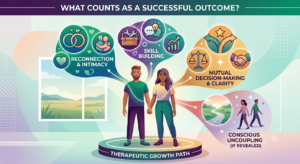
Couple Counselling Outcomes
There is no single model for a successful same-sex relationship, especially when we’ve attempted to integrate the model we (unconsciously) observed in our parents’ behaviour and found (much to our surprise) that it just doesn’t work in our own partnership.
A healthy partnership might be monogamous, open, married, unmarried, child-free, parenting, long-distance or structured in ways that are entirely individual to the people involved.
What matters is whether the partners can develop a relationship that they understand, negotiate and genuinely consent to.
Sometimes couples become stuck because they are trying to solve the wrong problem. They may repeatedly argue about behaviour without understanding the pattern underneath it.
Specialist therapy for queer couples can offer a different opportunity: to slow things down, understand what is happening between you and consider what you both want to change.
The purpose is not for a counsellor to decide who is right. It is not to impose a conventional relationship model. And it is not to turn every LGBTQ+ relationship difficulty into an issue about sexuality.
Instead, counselling can help a couple become more curious about their own relationship, recognise recurring patterns and develop their own ways of responding differently. This reflects the systemic and psychodynamic approach used by LGBTCoupleCounselling.co.uk.
When a Specialist LGBT Couple Counsellor Could Help

Couple Counselling
You do not need to wait until your relationship is in crisis before seeking support.
Counselling may be worth considering when you are experiencing:
- Repeated arguments that never seem to resolve
- Communication that has broken down
- Differences about monogamy or opening the relationship
- Difficulties around coming out or visibility
- Family-related conflict
- Emotional or sexual intimacy problems
- Feelings of distance, resentment or insecurity
- The same relationship pattern repeating despite attempts to change it
You also do not necessarily need to arrive with a clearly defined problem.
Sometimes the starting point is simply:
“We know something isn’t working, but we don’t understand why.”
That can be enough to begin exploring what is happening.
A confidential space for your relationship
Same-sex relationship challenges are not necessarily caused by being in a same-sex relationship. But the social, cultural and personal experiences surrounding LGBTQ+ lives can sometimes become part of the relationship’s difficulties.
Recognising those influences can make it easier to understand what is happening between partners.
If you and your partner are struggling with communication, intimacy, identity differences, family pressures or another recurring relationship difficulty, LGBT couple counselling can provide a confidential space to explore it together.
LGBTCoupleCounselling.co.uk provides specialist, relationship-affirming counselling for LGBTQ+ couples, using an integrated systemic and psychodynamic approach. The work is tailored to the particular relationship rather than assuming that one model fits everyone. You do not need to have everything worked out before making contact; the first step can simply be talking about what is happening and deciding whether counselling feels appropriate.
Interested in a Counselling Appointment?

Dean Richardson MNCPS (Accred/Reg)
LGBTQ+ Couple Counselling was established in 2010 by Dean Richardson MNCPS (Accred/Reg) and specialises in online video counselling for LGBTQ+ relationships.
Dean is a postgraduate-qualified systemic and psychodynamic couple counsellor with more than 27 years’ counselling experience. His private counselling service provides specialist relationship counselling online through secure video, allowing couples to work with a counsellor without, say, having to travel to a counselling office each week.
Find out more about LGBTQ+ Couple Counselling for Couples…




0 Comments