

 Why Do We Keep Having the Same Argument?
 Challenges in Same-Sex Relationships: Beyond Common Couple Struggles
 Top Ten Benefits for a Gay Couple Working with a Gay Counsellor…
 How to Rebuild Trust After Cheating: Can an LGBTQ+ Relationship Recover?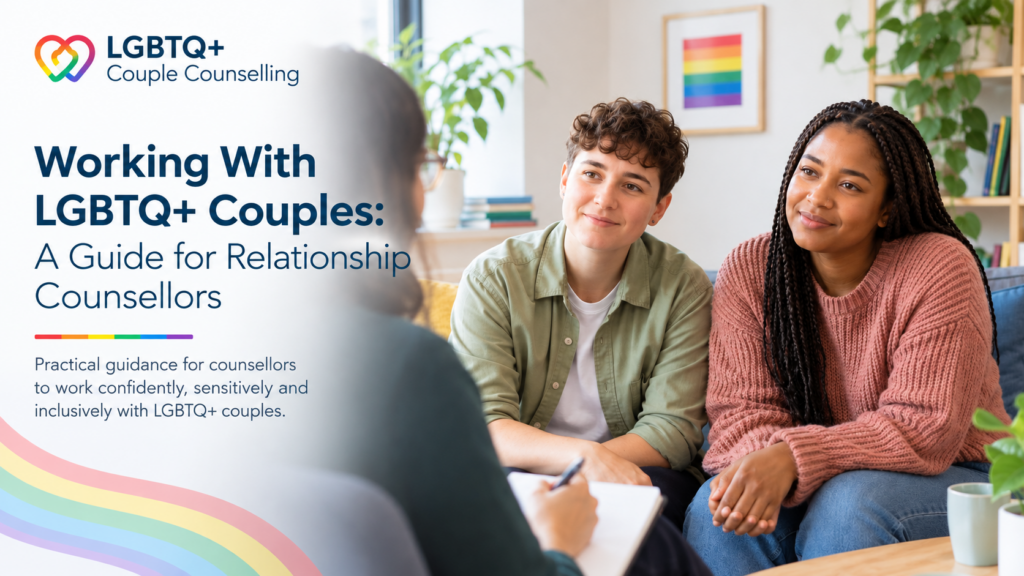
This article is intended for qualified/experienced couple counsellors who have either never worked with LGBTQ+ relationships before or who are seeking additional awareness of the distinct needs of their diverse couples, without this being a “how to…” guide.
Hi 👋 I’m Dean RIchardson MNCPS (Accred/Reg); an experienced counsellor having almost three decades of experience (eighteen of them in relationship work).
I specialise in LGBTQ+ couple counselling work held over secure video (Zoom, etc) and this article is my contribution to those new to LGBTQ+ couple counselling.

Of course, we expect qualified couple counsellors to be, or become, confident in working with couple relationships. But multiple training courses available to British counsellors include comparatively little specific training in, or experience of, working with LGBTQ+ couple relationships.
Being a qualified couple counsellor (in the unfortunate position of having little comprehension of LGBTQ+ partnerships) does not necessarily mean that you need an entirely different therapy framework or theoretical model to work with LGBTQ+ partners. The fundamental tasks of couple counselling remain the same: to understand what is happening within the relationship, help the partners recognise patterns that have become problematic, and create the conditions in which they can make their own informed choices about what happens next.
But, in this counsellor’s opinion, what does need to improve is counsellors’ awareness of the assumptions they may unknowingly bring into the room.
When working with gay/lesbian/queer partners, their lifestyle and relationship choices (unfamiliar to heteronormative therapists) may disrupt our reflexivity processes, leading us towards becoming inflexible and opinionated. We can improve our service by at least bearing in mind that the couple in front of us likely formed their relationship independent of their (and our) parents’ beliefs, attitudes, and behaviours.
An LGBTQ+ couple should not have to educate their couples therapist about basic aspects of LGBTQ+ lives while simultaneously trying to deal with their relationship difficulties.
As counsellors none of us can be expected to know every possible configuration of gender, sexuality, identity or relationship structure. But remaining unaware of such permutations is unethical at best (Continued Professional Development…!) and perhaps prejudiced at worst.
So, having worked with LGBTQ+ couples for almost two decades, let me pass on to you some of my knowledge and experience that might help to give you, the interested couple counsellor, a head start on working therapeutically with LGBTQ+ couples.
Educating Ourselves
It is important that our unawareness of LGBTQ+ relationships does not disrupt the couple facing us.
No one is asking you to know everything about LGBTQ+ lifestyles, choices and decisions, but you are being asked not to treat LGBTQ+ relationships as mysterious or fundamentally different.
Applying genuine curiosity, cultural humility, appropriate professional knowledge and a willingness to recognise when your own assumptions have entered the counselling room are authentic qualities that all couple counsellors can apply.
When asking yourself, “As a couple counsellor, how do I counsel LGBTQ+ couples?” the following resources can be a helpful start:
- Pink Therapy.
The UK’s largest independent therapy organisation specialising in Gender, Sex, and Relationship Diversities.
https://pinktherapy.org/ - The Gottman Institute (LGBTQ+ Couple Therapy Resources & Training).
Known globally for evidence-based couple therapy, Gottman integrated research specifically focusing on same-sex couples through their Same-Sex Couples Study.
https://www.gottman.com/ - Gendered Intelligence.
A trans-led charity that offers specialised training, clinical supervision networks, and educational resources specifically for mental health professionals and relationship therapists.
https://genderedintelligence.co.uk/ - COSRT (College of Sexual and Relationship Therapists).
As a professional body for psychosexual and relationship therapists, COSRT frequently hosts CPD courses and self-access modules focused on “Queering Therapy Practice” and GSRD.
https://www.cosrt.org.uk/ - Modern Sex Therapy Institutes (MSTI).
MSTI provides specialised certifications and continuing education courses in LGBTQIA+ Affirmative Therapy and Clinical Sexology.
https://modernsextherapyinstitutes.com/ - LGBT Couple Counselling (Blog)
At risk of blowing my own horn, I regularly blog about LGBTQ+ couples and their needs from counselling.
https://LGBTCoupleCounselling.co.uk/blog
What does LGBTQ+ stand for?
 Let’s begin with a simple clarification of what LGBTQ+ stands for:
- L: Lesbian
- G: Gay
- B: Bisexual
- T: Transgender
- Q: Queer/Questioning
- +: All other welcome orientations and permutations
Although each individual may identify strongly with one label more than another, they also have the right to alter that label at any part of their lives. A colleague who had described himself as gay for years, he once shared with me: “I’m a gay man in a non-monogamous, intimate relationship with a FTM person – why wouldn’t I describe this as a ‘queer’ relationship?”
What about GSRD?
GSRD stands for Gender, Sex, and Relationship Diversity – an alternative description to LGBTQ+.
The couple’s relationship is your client
This is more for counsellors trained in individual counselling.
In general, couple counselling is not simply individual counselling with two people sitting together. This is a core error that those inexperienced in practising couple or relationship counselling make.
With many theoretical models and approaches to couple counselling, it’s the couple’s relationship itself that is the counsellor’s client; the relationship becomes the focus of the work to be done.
This means that theoretical models, frameworks and intervention techniques that focus on the individual provide little assistance alone to the individual counsellor working with a couple’s relationship. How, for example, does one ask the relationship the open question:“how do you feel about this?” ?
Individual Theoretical Frameworks != Couple Counselling
As an example, by applying an integrated systemic/psychodynamic theoretical model to couple counselling, the systemic perspective asks what happens between the partners: who responds to whom, what happens next, and how the resulting pattern reinforces itself. The psychodynamic perspective can add consideration of less conscious emotional processes, previous experiences and anxieties that may be brought into the relationship. Circular questioning allows us to prepare interventions that may help the relationship express itself.
For the individual counsellor, it can be tempting to interpret a relationship difficulty as an individual problem:
One partner is anxious and the other is avoidant.
Whereas, a systemic perspective might instead ask:
“What happens between you both when one partner becomes anxious?”
Describing the relationship is the primary client, and using curiosity to generate new information about the couple’s “system”, invites the couple to discover what they may have been turning a blind eye to for years.
New information can create new possibilities, which can then allow the couple to make different choices. This basic principle applies regardless of sexual orientation or gender identity, but the context surrounding the relationship may be different.
Do not assume that the couple is heterosexual (by default)
Heteronormativity – within the counsellor’s mind – can enter the counselling relationship in a remarkable number of seemingly ordinary ways. As counsellors working with diverse couple partnerships, our reflexivity must be highly active to watch out for our assumptions of what a “normal” couple relationship is supposed to be.
For example:
- assuming there is a “male role” and a “female role”;
- assuming one partner is naturally more dominant and the other more submissive;
- assuming one partner will take responsibility for domestic tasks because of their gender;
- assuming sex follows heterosexual conventions;
- assuming marriage, cohabitation or children are necessarily the couple’s goals;
- assuming monogamy without asking;
- assuming that non-monogamy is unethical;
- assuming both partners have the same understanding of fidelity;
- assuming both partners are equally open about their sexuality;
- assuming that someone’s gender identity tells you something about their role within the relationship;
- assuming that a bisexual partner’s relationship with a same-sex partner is fundamentally different from their previous or future relationships with people of another gender.
The couple counsellor can miss that they’re making such assumptions because they often originate in the cultural model of relationships that most of us have encountered throughout our lives.
The issue is not that heterosexual relationships provide no useful information about relationships. They obviously do. The issue is treating heterosexuality, binary gender roles or monogamy as the default template against which an LGBTQ+ relationship is measured.
There is no requirement for an LGBTQ+ relationship to reproduce a heterosexual relationship structure in order to be healthy. A couple may be married or unmarried, monogamous or consensually/ethically non-monogamous, child-free or parenting, and living together or separately. Their relationship may also change its structure over time.
As the counsellor, your task is not to decide which arrangement is “normal”; it is to understand what the partners have actually agreed to, whether those agreements are understood by everyone involved, and what happens when those agreements become difficult to maintain.
Learn to recognise when you do not know
One of the most important skills for a counsellor working outside their usual experience is being able to notice their own uncertainty.
You might hear:
“We’re open, but we have a don’t-ask-don’t-tell agreement.”
You might hear:
“I’m non-binary, but I don’t use that identity at work.”
Or:
“We’re married, but we don’t live together.”
Or:
“He’s my primary partner.”
Or:
“She transitioned during our relationship.”
Or:
“We’re polyamorous, but this particular relationship is monogamous.”
None of these statements should automatically be regarded by you as a clinical problem (subsequently informing your hypotheses and interventions).
They are information.
The inexperienced couple counsellor may immediately attempt to translate them into familiar categories. The more useful response is to become interested in what those terms mean for this particular couple.
You do not need to know precisely what a couple’s relationship structure means before you can work therapeutically with it.
You need to understand what it means to them. This distinction is fundamental.
Curiosity is useful; pretending to understand is not
There is a significant difference between inappropriate questioning and therapeutic curiosity. Inappropriate questioning can make clients feel that they have become an educational resource for the counsellor.
Curiosity, by contrast, is directed towards understanding the relationship.
For example, rather than:
“So how does polyamory work?”
you might ask:
“When you describe your relationship as polyamorous, what agreements have the two of you made that are particularly important to your relationship?”
Rather than:
“Which one of you is the man in the relationship?”
There is simply no need to ask such questions because they highlight your ignorance rather than inviting the couple towards helpful curiosity.
Instead:
“How have the two of you divided responsibilities between yourselves?”
Rather than assuming that a transgender partner’s transition explains the relationship difficulties:
“What changed within the relationship during that period, and what stayed the same?”
Rather than assuming that a bisexual person’s attraction to other genders is relevant to a relationship conflict:
“What does attraction and fidelity mean within the agreement the two of you have made?”
Good questions seek information without imposing the counsellor’s interpretation.
You can say, “I don’t know”
A counsellor does not lose professional authority by acknowledging a gap in their knowledge.
Sometimes the most appropriate response is:
“I don’t have much experience with that particular relationship arrangement. Would you be willing to help me understand how it works for the two of you?”
That can be considerably safer than making an assumption.
There is, however, an important qualification: clients should not routinely have to provide their counsellor with basic LGBTQ+ education.
If you work regularly with LGBTQ+ clients, you have a professional responsibility to develop your knowledge through training, reading, supervision and continuing professional development.
There is a difference between asking a couple to explain their relationship and asking them to explain LGBTQ+ relationships. The first is appropriate. The second is usually your responsibility.
Do not turn every problem into an LGBTQ+ problem
The opposite error is just as important.
Once a counsellor becomes aware of minority stress, discrimination and LGBTQ+-specific experiences, there can be a temptation to interpret every difficulty through that lens.
That can be as reductive as ignoring LGBTQ+ context altogether.
A couple may have a communication problem because one partner withdraws whenever conflict begins. They may have an unresolved disagreement about money. They may struggle with different levels of sexual desire. They may have incompatible expectations about commitment. They may be affected by previous relationships. They may also experience homophobia, biphobia, transphobia, family rejection or concealment.
Sometimes these things are connected. Sometimes they are not.
Our task may be to help the couple find out.
Understand minority stress without pathologising LGBTQ+ identity
LGBTQ+ people can experience stress arising from discrimination, stigma, concealment, rejection and expectations of prejudice. These experiences can enter a relationship even when the relationship itself is supportive.
For example, a couple may have disagreements about:
- whether to hold hands in public;
- whether to disclose their relationship to particular family members;
- attending family events;
- workplace disclosure;
- introducing a partner to friends;
- safety when travelling;
- social acceptance;
- contact with a rejecting parent;
- whether children should be raised openly within an LGBTQ+ family;
- how one partner’s transition affects their public presentation as a couple.
These are not necessarily “communication problems” in isolation. There may be an external context that the couple is negotiating.
The counsellor therefore needs to be able to hold two ideas simultaneously:
The relationship may have a problem.
The couple may also be responding to pressures that exist outside the relationship.
Those are not mutually exclusive.
A systemic approach naturally encourages the counsellor to look beyond the couple’s immediate interaction.
For LGBTQ+ couples, this can be particularly important.
When appropriate, ask about the systems surrounding the relationship:
- family;
- friends;
- LGBTQ+ community;
- workplace;
- religion or faith;
- children and previous relationships;
- social media;
- cultural community;
- healthcare;
- legal or immigration circumstances where relevant.
But again, do not assume that every LGBTQ+ client has the same experience of these systems.
A gay man may have an accepting family. A lesbian couple may experience conflict with one partner’s family but not the other’s. A bisexual person may experience invalidation from both heterosexual and LGBTQ+ communities. A trans person may have strong social support. A queer person may not identify particularly strongly with LGBTQ+ community life at all.
The counsellor needs to discover the client’s actual experience rather than applying a standard narrative.
Be particularly considerate with bisexual and pansexual clients
One form of heteronormativity that can be missed is monosexism: the assumption that people are either heterosexual or homosexual.
For a bisexual or pansexual client, this can appear in questions such as:
“When did you realise you were gay?”
or assumptions such as:
“You are in a same-sex relationship, so you’re a gay couple.”
The partner’s current relationship does not necessarily define their sexual orientation.
Similarly, bisexuality should not automatically be interpreted as uncertainty, indecision, a transitional identity or evidence of greater likelihood of infidelity.
If sexuality is relevant to the couple’s difficulty, explore the couple’s actual experience rather than relying on stereotypes.
Gender identity – not relationship role
A person’s gender identity does not tell you how they behave within their relationship.
A transgender woman does not necessarily occupy a particular role. A non-binary partner does not necessarily have a particular sexual or relational role. A masculine-presenting lesbian does not necessarily want to be treated as the “male partner”. A feminine-presenting gay man does not necessarily occupy a particular relational position.
If you find yourself trying to work out who is “the husband” and who is “the wife”, stop and ask yourself why you need that information. Then, ask the couple about the actual division of responsibility, intimacy, decision-making and power within their relationship.
So let’s discuss more about gender and what you may be assuming.
Gender Pronouns
A person may use pronouns different from those assigned to them at birth† or to how they present visually to you.
- She/Her/Hers: Commonly used by trans women, cisgender women, and some non-binary people.
- He/Him/His: Commonly used by trans men, cisgender men, and some non-binary people.
- They/Them/Theirs: Singular gender-neutral pronouns, widely used by non-binary, genderqueer, agender, and gender-fluid individuals.
Many individuals use multiple sets of pronouns. This indicates comfort with any listed set, sometimes depending on context or preference:
- She/They
- They/She
- He/They
- They/He
- Any Pronouns
- All Pronouns
† Note: we used to use the phrase “preferred pronouns”, but a trans person uses pronouns according to the gender they recognise, rather than the gender they “prefer”. See also Trans Language Glossary…
Gender does not equal sexual preferences
Sexuality and relationship counselling frequently overlap around intimacy, but counsellors can become surprisingly uncomfortable when the couple’s sexual practices do not correspond to heterosexual expectations.
Avoid assuming:
- who initiates sex;
- who penetrates;
- who receives;
- that both partners want the same sexual practices;
- that sexual roles are fixed;
- that sexual frequency is necessarily the problem;
- that sexual exclusivity is assumed;
- that a change in sexual behaviour means a change in sexual orientation.
A couple’s sexual relationship should be explored in the same professional, non-judgemental way as any other aspect of their relationship.
When appropriate, ask what particular behaviour means to the partners.
A disagreement about sex may actually concern rejection, reassurance, body image, shame, attraction, vulnerability, trust or fear of abandonment.
Don’t assume that non-monogamy is a problem
Some LGBTQ+ couples are consensually non-monogamous. The existence of more than two partners does not, by itself, establish that the relationship is dysfunctional.
The counsellor should instead establish:
- who is in the relationship;
- what agreements exist;
- what each person understands those agreements to mean;
- how agreements are negotiated;
- whether consent is ongoing;
- where boundaries lie;
- what happens when agreements change;
- whether everyone involved has sufficient information to make informed choices.
The same principle applies to throuples and other relationship groups.
The question is not:
“Why aren’t you monogamous?”
It is:
“How does your relationship work, and where is it currently becoming difficult?”
This is particularly compatible with systemic thinking because the counsellor is trying to understand the relationship system rather than forcing it into a predetermined structure.
Pay attention to power and consent
An affirmative approach does not mean accepting every relationship arrangement uncritically. Counsellors still need to assess safety, coercive or controlling behaviour, abuse and consent. This becomes particularly important when relationship structures are unfamiliar to the practitioner.
A counsellor should not confuse difference with dysfunction. But neither should they confuse an unfamiliar relationship structure with evidence that everything occurring within it is consensual or safe.
For example, there is an important difference between:
“We have agreed that either of us can have sexual partners outside the relationship.”
and:
“My partner says I am not allowed to object when they have sex with somebody else.”
The first describes an agreement. The second may require exploration of coercion, boundaries and power.
The same principle applies in monogamous relationships.
LGBTQ+ affirmative practice is not the absence of professional judgement. It is the absence of pathologising identity or relationship structures simply because they differ from the counsellor’s expectations.
Consider intersectionality
“LGBTQ+” is not a single experience.
Sexual orientation and gender identity intersect with:
- race and ethnicity;
- disability;
- age;
- socioeconomic circumstances;
- religion;
- culture;
- immigration status;
- family background;
- geography.
These intersections can affect both the relationship and the couple’s experience of seeking counselling.
For example, a couple may encounter different reactions to their relationship because of race as well as sexuality. A disabled LGBTQ+ couple may face accessibility problems within LGBTQ+ spaces. A person from a religious background may experience conflict between their relationship and their family or community.
The counsellor should therefore avoid replacing one stereotype with another:
“LGBTQ+ people have {these} experiences.”
A more useful question is:
“How do you image being LGBTQ+/gay/lesbian/etc/ affected your experience, if at all?”
Create an affirming practice before the couple engages
Affirmative practice is not simply something the counsellor says during a session. It begins before the first appointment.
Consider your:
- website;
- intake forms;
- consent documentation;
- booking system;
- pronoun fields;
- terminology;
- examples used in questionnaires;
- assumptions within assessment forms;
- waiting-room materials;
- referral information.
If your intake form asks:
“Name of husband/wife”
You have already communicated something about the relationship model you expect.
If it asks:
“Partner’s name and relationship to you”
You have created considerably more space.
The same applies to language. Do not assume “husband”, “wife”, “boyfriend” or “girlfriend” unless the client uses those terms.
Use the terminology the clients use for themselves and their relationship. If in doubt, ask.
Be prepared to repair mistakes
You will sometimes get something wrong.
You may use the wrong pronoun. You may misunderstand a relationship agreement. You may use a term the client does not use.
The important issue is what happens next.
A simple:
“I’m sorry. I used the wrong pronoun.”
is usually preferable to a long explanation.
Likewise:
“I think I made an assumption there. Let me go back and check that I have understood you correctly.”
Repairing a therapeutic rupture can itself demonstrate something important: the counsellor can make a mistake without becoming defensive, and the relationship can recover from it.
Notice what your own discomfort is telling you
Your internal reaction is information, not necessarily truth. A countertransference response may be giving you information that one or both partners are quietly holding to themselves (yes, we can have countertransference responses to a relationship).
If you feel confused by a relationship structure, ask yourself:
What exactly am I confused about?
If you feel that something is “unusual”, ask:
Unusual according to whom?
If you feel an urge to give advice, ask:
Am I responding to something genuinely unsafe, or am I uncomfortable because this relationship differs from relationships I know?
If you find yourself mentally assigning gender roles, ask:
What evidence have I actually been given for that assumption?
This kind of self-reflection is part of professional competence.
The aim is not to become completely free of assumptions. That is unrealistic.
The aim is to become sufficiently aware of them that they do not quietly become part of the therapy.
Do not confuse specialist knowledge with having all the answers
A counsellor who focuses on LGBTQ+ relationships does not need to know everything about every LGBTQ+ identity or relationship configuration.
In fact, claiming to have such expertise could be unrealistic without having attended additional training/CPD.
Specialist competence means having enough knowledge to recognise the relevant issues, avoid predictable assumptions, understand the impact of minority stress and discrimination, work affirmatively, recognise your own limits, and know when further training, supervision or referral is appropriate.
It also means possessing the appropriate relationship counselling competence.
Being LGBTQ+ friendly does not automatically make someone a competent couple counsellor.
Individual counselling and relationship counselling require different theoretical and practical skills. The two areas of competence therefore need to meet:
LGBTQ+ affirmative practice + competent relationship counselling.
One without the other is incomplete.
Useful question for your first session
Rather than arriving with a checklist of LGBTQ+ issues that you need to investigate, begin with the relationship.
You might ask:
“Before we get into the particular problem that brought you here, can you tell me a little about how your relationship works and what is important for me to understand about the way the two of you relate to each other?”
That question leaves room for the couple to tell you what matters.
You may learn about their gender identities. You may learn about their sexual orientations. You may learn about a non-monogamous relationship structure. You may learn about family rejection.
You may learn none of these things, and that is fine too.
The point is that the couple gets to tell you what is relevant rather than the counsellor deciding in advance what an LGBTQ+ relationship must involve.
Your position may be: “Teach me about your relationship”
There is an important distinction between being curious about LGBTQ+ people and being curious about the particular people sitting in front of you.
The first can become intrusive.
The second is fundamental to good couple counselling.
Your professional knowledge should provide the framework.
The couple provides the particular information, and your role is to bring the two together.
This fits naturally with a systemic approach. The counsellor listens for patterns, differences, responses and connections while remaining open to being corrected by the couple’s actual experience.
The goal is therefore not to become an expert on every possible LGBTQ+ relationship.
It is to become a counsellor who can sit comfortably with a relationship that is unfamiliar, recognise when your own assumptions are getting in the way, ask respectful questions when you need more information, and then return your attention to the relationship itself.
And sometimes that curiosity is where the therapeutic work begins.
A final checklist for couple counsellors
Training/Qualification
- Am I actually trained/qualified to work therapeutically with couples?
- Do I understand the theoretical model I am using?
- Have I undertaken specific LGBTQ+ affirmative CPD?
Assumptions
- Am I assuming heterosexual gender roles?
- Am I assuming monogamy?
- Am I assuming marriage, children or cohabitation?
- Am I assuming that sexual orientation determines relationship roles?
- Am I assuming that bisexuality or trans identity explains the presenting problem?
Curiosity
- Have I asked the couple what their relationship means to them?
- Have I distinguished what I know from what I am assuming?
- Can I comfortably say “I don’t know” when appropriate?
- Am I asking about their relationship rather than making them explain LGBTQ+ people to me?
Context
- Have I considered minority stress and discrimination?
- Have I explored relevant family, social and cultural pressures?
- Have I considered intersectionality?
- Have I assessed safety, consent, coercion and power without pathologising difference?
Therapeutic practice
- Am I treating the relationship as the focus of the work?
- Am I avoiding taking sides?
- Am I helping the couple understand their interactional patterns?
- Am I allowing the couple to determine what they want their relationship to become?
The most important shift is perhaps a simple one. You do not need to walk into an LGBTQ+ couple counselling session knowing everything about LGBTQ+ relationships. You do need to walk into it knowing that your assumptions are not the same thing as the couple’s reality.
Good LGBTQ+ couple counselling does not require the counsellor to have an answer for every unfamiliar situation. It requires the counsellor to have sufficient knowledge, humility and relationship expertise to become curious about what they do not yet understand.
Glossary of Terms in Use by Trans People
Language preferences vary by person, but current trans-inclusive usage favours terms describing assigned sex at birth rather than born sex, emphasising self-determined gender identity.
| Term / Abbreviation | Stand-for / Alternative | Definition & Usage Context | Usage Notes |
|---|---|---|---|
| AFAB / AMAB | Assigned Female at Birth / Assigned Male at Birth | Refers to the sex designation assigned on a birth certificate based on external anatomy. | Widely preferred over “born a woman/man”. Used mainly when specific birth-assigned details are relevant. |
| AGAB | Assigned Gender at Birth | General umbrella acronym covering AFAB and AMAB. | Used to discuss gender assignment processes generally without specifying a sex. |
| Trans Man / Trans Woman | Transgender man / Transgender woman | A man who was assigned female at birth, or a woman who was assigned male at birth. | Preferred over legacy clinical terms like “FTM” or “MTF”, though some individuals still use the acronyms as personal shorthand. |
| Non-Binary (Enby) | — | An umbrella term for gender identities that fall outside the male/female binary. | Often abbreviated as NBi or NB. The spoken phonetic term “Enby” is used by many as a noun. |
| Cis / Cisgender | — | Describes a person whose gender identity aligns with the sex assigned to them at birth. | Standard language used across medical and social settings as the counterpart to “transgender”. |
| Gender-Affirming Care | Formerly “Sex Reassignment” / “Sex Change” | Medical, surgical, or psychological healthcare that supports an individual’s transition. | Preferred over terms like “sex change operation,” which are viewed as inaccurate and outdated. |
| Deadname | — | The legal or birth name a trans person no longer uses. | Using this name after a person has changed it is called “deadnaming”. Avoid using a person’s deadname unless explicitly requested. |
| Gender Euphoria | — | Positive feelings of comfort, joy, and alignment regarding one’s gender identity or presentation. | Often highlighted alongside or instead of “gender dysphoria” to emphasize positive experiences. |
| Gender Expression | — | External presentation through presentation, clothing, haircut, behavior, or voice. | Distinct from gender identity (e.g., a trans man can have a feminine gender expression without changing his male identity). |
| Person with a Trans History | Transgender person | Refers to someone who has transitioned and prefers to frame transness as a past experience rather than a main identity. | Preferred by some binary trans individuals who simply view themselves as men or women. |
Bibliography
8 References
Accepting Uncle Murphy (Instagram). (2026). History of the "L" coming first in LGBTQ. https://www.instagram.com/reel/DZNYr2Dxr0q/?stkn=ZzlzNDlsM2htNXRm
Bacon, D. (2017). How to be the man in a relationship (The Modern Man). https://www.themodernman.com/blog/how-to-be-the-man-in-a-relationship.html
Citation: Stoller, N. E. (1998). Lesbian Involvement in the AIDS Epidemic: Changing Roles and Generational Differences. (in: "Lessons from the Damned: Queers, Critiques, and Contradictions", Routledge). https://www.amazon.co.uk/Lessons-Damned-Queers-Junkies-Respond/dp/0415919614
GLAAD. (2022). Glossary of Terms: Transgender. https://glaad.org/reference/trans-terms/
Gurman, A. S. A. B. (2014). Individual therapy for couple problems: Perspectives and pitfalls. (Journal of Marital and Family Therapy, 40(4), 420–435). https://www.google.com/search?q=https://doi.org/10.1111/jmft.12066
Pink Therapy et al. (2015). Gender, Sex, and Relationship Diversity (GSRD). http://pinktherapy.org/
Richardson, D. A. (2026). How does Couple Counselling Actually Work? https://lgbtcouplecounselling.co.uk/weblog/2026/09/02/how-does-couple-counselling-actually-work/
Santosha, S. (2026). Men & family counselling. https://menandfamilycounselling.com.au/couple-counselling






0 Comments